
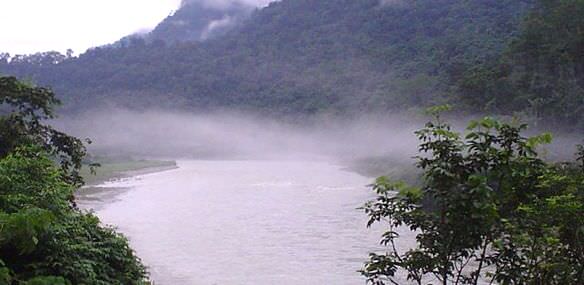
Affected Citizens of Teesta (ACT) - Striving to protect Sikkim
Welcome to ACT, an organization of the indigenous Sikkimese citizens to protect the land and people from the threat to the Biodiversity Hotspot (Khangchendzonga Biosphere Reserve), endangering the demographic profile of the indigenous primitive Lepcha tribes and the right to live in one's homeland with dignity and security due to implementation of numerous mega hydro-electric power projects in one go.
Friends and supporters, read and take ACTion!
HEADLINES
ACT welcome People's Decision to oppose Hydel Projects in Dzongu
What used to be the wisdom of a vanguard minority for many years, has entered the consciousness of the common man. At a coordination meeting at Hee-Gyathang on May 10, 2015, the people of Dzongu expressed a bold stance over impending hydropower projects in the Lepcha reservation and its immediate vicinity. Headed by the elected representatives of Dzongu including Panchayats and area MLA Sonam Gyatso Lepcha, former Cabinet Minister Energy and Power, the assembly resolved to withdraw consent for the construction of Panan HEP and Teesta Stage IV HEP expressed or implied earlier. Sonam Gyatso Lepcha left now doubt that these projects cannot be imposed on the protected area against the will of its population. Making mention of tourism, organic farming and cardamom plantation, he reminded the participants that hydropower is by far not the only option for development in Dzongu.
Tseten Lepcha, working president of the Affected Citizens of Teesta, welcomes the clear verdict of the meeting in a press statement released on May 13, anticipating that it would bring unity and peace and "usher in lasting prosperity more than what the mostly failed and destructive hydro projects can". Finally, Tseten Lepcha affirms his optimism that "this decision will go a long way in protecting the sanctity of Dzongu as enshrined in the old laws of Sikkim and protected by the article 371(f) of the Constitution of India."
Document: ACT Press Release - May 13, 2015
Petition to the National Green Tribunal
Sikkim NOW!, March 14, 2015, p. 4
The Working President of Affected Citizens of Teesta, Tseten Lepcha, acting in his individual capacity as "a person living in the buffer zone of the Khangchendzonga Biosphere Reserve/Khangchendzonga National Park and being affected by the decision to reduce the ESZ and not necessarily representing any organization", has approached the National Green Tribunal challenging the Notification of the Ministry of Environment and Forests reducing the Eco-Sensitive Zone buffer around national parks from the existing 10 kms to an insignificant 25 to 200 metres. The National Green Tribunal, Eastern Zone Bench, has admitted Mr. Lepcha's petition.
The Ministry of Environment and Forests, it may be recalled, had quietly put out the final notification reducing these protected zones around eight national parks and sanctuaries from the existing 10 km to eco-sensitive zones ranging from 25 to 200 metres. These covered the protected areas of Pangolakha, Singba Rhododendron, Fambonglho, Kyongnosla Alpine wildlife sanctuaries and the Khangchendzonga National Park, Mainam Wildlife Sanctuary, Kitam Bird Sanctuary and Barsey Rhododendron sanctuary are publicized by the Ministry.
While challenging the notification before the National Green Tribunal, Mr. Lepcha has argued that the Gazette Notifications may cause disturbance to the wildlife and its habitats and also open opportunities for development activities posing a threat to wildlife.
The MoEF had not disposed off the objections and suggestions lodged by a number of people including the SIBLAC and Affected Citizens of Teesta and other environmental activists across the country, ignoring the very procedures before the publication of Notifications which had also by-passed the National Board for Wildlife under the same ministry, Mr. Lepcha said.
The NGT's Eastern Zone Bench in Kolkata admitted the petition on 27 February and issued notices to the Central and state respondents, adding that the Tribunal is satisfied with the pleadings made in the original application for adjudication on applying the environmental jurisprudence vis-a-vis the concerned Act and notifications thereof.
The NGT, Zonal bench headed by Justice Pratap Kumar Ray and Prof. PC Mishra, directed the respondents to file affidavit in respect of the contentions made in the original application.
Mr. Lepcha maintains that neither were their suggestions and complains on the Draft notification acknowledged, nor were they informed of any action taken on the matter, "grossly ignoring the very procedures laid down before the final publications of Notification".
The Ministry has not changed anything from the draft Notification which was published in February last year and has instead added three more national parks and sanctuaries - Mainam Wildlife Sanctuary, Kitam Bird and Barsey Rhododendron sanctuary. Sikkim has a total of eight protected areas - one national park and seven wildlife sanctuaries, covering 2,183 sq km area of the state.
In a press statement issued on Friday, Mr. Lepcha argues that the ESZ did not necessarily hinder any developmental activities as there were provisions due to which many activities were permitted, some regulated and few prohibited.
"The classic example of development work with proper monitoring by environmental agencies is the Skywalk at Baleydunga. This project is in the core zone of Maenam Wild Life sanctuary, yet clearance has been given after the conditions were followed," he points out, adding that the reduction of the ESZ "was mooted with the wrong notion that there were won't be any developmental work by few individuals, which probably misled the Govt and general public, in the process has caused serious damage to the rich bio-diversity of Sikkim."
In October last year, Mr. Lepcha had also served a legal notice to the Ministry of Environment and Forests in this connection and when this fetched no response, he took the present step of approaching the National Green Tribunal.
"... having exhausted all available options and getting no positive response, this petition has been filed with the prayer that the Notification Dated 27 August 2014 of the eco-sensitive zones around the protected areas in the state of Sikkim declaring the ESZ be quashed and fresh notification should be issued in accordance with the legislative policy regarding the same. Further, prayer for stay of the new notification has been submitted till the pendency of the application and till such time the old 10 km zone be continued," Mr. Lepcha has petitioned.
Document: Press Release Tseten Lepcha - March 13, 2015
Stage Win for ACT
The National Green Tribunal has overturned the appeal by NHPC, Government of Sikkim and the Union Ministry of Environment and Forests to technically dismiss a petition by the people of Sikkim.
The Judge and the Expert Member of the Tribunal decided to tolerate the delay in filing the petition and, instead, passed orders for hearing the case on merit. The petitioners requested that the Environmental Clearance issued by MoEF to NHPC for the Teesta HEP Stage IV over Teesta in North Sikkim be cancelled.
Read more: ACT Press Release - September 19, 2014
Document: Order of the NGT, issued August 29, 2014
ACT Tail Wind for Government Commitment
Pleased with the Sikkim government's newfound fondness for the ancient rights of the original Sikkimese in general and the protection of Article 371F of the Constitution in particular, members and leadership of the Affected Citizens of Teesta (ACT) pledge full support to the commendable intentions of the new cabinet.
In a press release issued by Working President Tseten Lepcha, the organization states that the old laws have been disregarded in previous terms especially in connection with hydel projects and that, apart from enforcing laws in effect, violations committed in the past have to be re-assessed as well.
Citing the influx of outsiders working at the projects sites, ACT demands those to be sorted out who managed to have their names included in electoral rolls by illegal means and that "legal ways and means are explored to stop rampant inclusion of non Sikkimese in voters list without fulfilling the legal formalities."
Stressing the importance of Darbar Notification No. 3069 of 24th March 1958 dealing with the protection of indigenous property and prosecution of infringements against the related royal edicts, Tseten Lepcha insists on an implementation true to letter and spirit.
Read more: ACT Press Release - June 2, 2014
DAWA LEPCHA: SOME PONDERINGS ON THE HYDRO PROJECTS
Sikkim Express, August 11, 2013, p. 4
The horror of the devastations caused by the cloud burst and the subsequent flash flood in the state of Uttarkhand is still very fresh in our minds. In fact, the nightmare still continues, for the local people there, with the monsoon rain still pounding the region. Though it was downplayed and subdued, the role of the numerous hydro electric projects and their dams and tunnels have been voiced by the locals and experts too in the cause and aggravation of the calamity. The government, of course, denied these aspects as was expected, like in our own state during the 18 September 2011 earthquake.
Back home in Sikkim, the Rangyong river on which the very controversial Panang 300 MW is planned in Dzongu, North Sikkim, has been acting strange since 2007. It has experienced flash floods of very dangerous level, rain or no rain. On the night of 16th August 2007, under a starry night as per the locals, the river came down raging, killing four workers at a survey camp at Lingzya village with two barely escaping with their dear life. The latest has been in the night of 20th July 2013, after which alerts were sounded for the towns situated along the Teesta. The flash flood itself went largely unnoticed though the folks living in the nearby vicinity of the Rangyong had a jittery night.
In Sikkim, these numerous unnecessary hydro projects that are swallowing up the entire river system of the state, are a sure shot recipe for calamity in the long run for interfering too much with the affairs of nature and not just this, we see a lot other calamities in the making from socio-demographic, cultural, health etc. to political domain in the long run. All these while the revenue returns and profit aspects seem highly doubtful, as we go a little deeper into the MOUs and other documents executed, all of which are inclined towards the companies than for the state government and the public. Our rivers have been sold at pittance in the greed and hurry to make hay while the sun shone. You know what I mean.
Full Text: Some Ponderings on the Hydro Projects by Dawa Lepcha
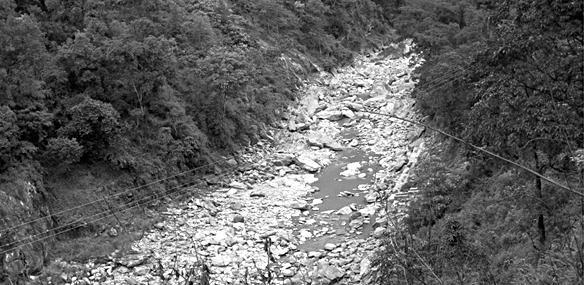
EARTHQUAKE REHABILITATION: TSETEN LEPCHA FED UP
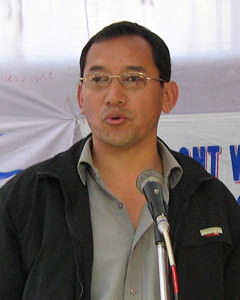
In a Press Release of March 8, 2013, ACT Working President Tseten Lepcha presents a write-up on the scandalous neglect of the State Government in respect to Chungthang, the area worst hit by the earthquake of September 18, 2012. Tseten makes out misuse of funds thought for rehabilitation and gives evidence of the disastrous consequences of excessive blasting for Teesta Stage III.
"It is beyond any doubt that the national and international focus on the 18th September earthquake was due to the unfortunate deaths of innocient citizens and the most devastating destruction of properties at chungthang. The face of the destruction, in fact, was the collapsed houses at chungthang which was beamed day and night in the media that generated much support for Sikkim. But when it came to reaching relief, the actual place of destruction and the victims were neglected and the funds diverted to other places and used for other works which did not need so much urgency. In fact, the very priority list of the state Govt. does not even mention the most affected area. ...
There is no escaping the fact that the entire state with its young mountains has been battered with extensive brute force and Chungthang being the dam site is worst hit. It is any one's guess that the severely disturbed area just needed another jolt to cause devastation as that happened on the 18th of Sept 2011.
Therefore, the argument that there is no link between the earthquake and hydro projects is completely wrong. It is proven beyond any doubt that the severity of destruction in Chungthang and surrounding areas was compounded by the destructive mega hydroelectric power project.
The entire funds donated by Teesta Urja Ltd. for the earthquake was deposited in the CM's relief fund and not provided to the project affected area directly."
Full Press Release: Chungthang - The Kalapani of the 21st Century
CHRONICLE
ACT alleges Rs. 9.36 cr Scam in 'fake' Acquisition of Kashmal Forest
for Teesta Urja Project
Sikkim Express, November 17, 2013:
The Affected Citizens of Teesta (ACT) have urged the State government to take urgent action on alleged misappropriation of public money amounting to Rs. 9.36 crore by the Land Revenue Department through fake and illegal acquisition of Kashmal forest land for the Teesta Urja hydel power project in Chungthang, North Sikkim.
In their representation to the chief secretary posted last week, the ACT contend the Land Revenue department took Rs. 9.36 crores as compensation from the Sikkim Power Development Corporation (SPDC) and Teesta Urja Ltd. for the acquisition of Kashmal forest measuring 51.15 hectares without complying with relevant sections of the Land Acquisition Act. The entire acquisition proceedings have been made topsy-turvy, they said.
The ACT wrote that the State government had issued a notification on March 2007 for acquisition of land by the SPDC Ltd. on behalf of the Teesta Urja Ltd., but details of the Kashmal forest land have not been notified.
Terming the acquisition as illegal and invalid, the ACT submitted that the State government disrespected and disobeyed the orders given by the Supreme Court of India. They further submitted that private land measuring to 10.95 hectares in Shipgyer and Ramom villages for the project has been "concealed or made missing or might have been given to persons other than SPDC Ltd."
The ACT claimed that private land measuring to 42.46 hectares had been acquired but only 31.51 hectares of land have been transferred and mutated in the name of the SPDC Ltd. "The question that now arises is who has taken the remaining land measuring 10.95 hectares?"
The ACT concluded that the Sikkim government did not take prior approval under section 2 of the Forest Conservation Act for acquiring the Kashmal forest and did not issue any notification. ACT requested the State government to urgently comply with the relevant orders given by the Supreme Court, to refer the matter to the court for necessary clarification, or the matter must be urgently entrusted to the CBI for necessary investigation.
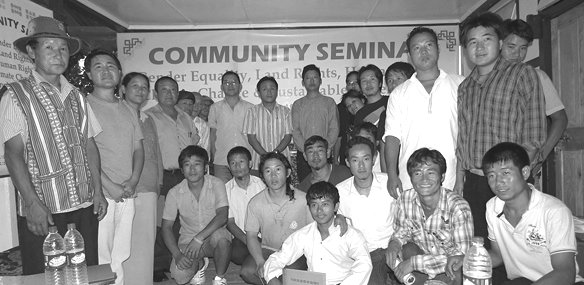
Community seminar held at Hee Gyathang
ACT resolves to support 'Save Kabi Longtsok Committee'
July 28, 2013: The Affected Citizens of Teesta (ACT) in collaboration with the North East Peoples Alliance conducted a community seminar at Hee Gyathang, Lower Dzongu, North Sikkim. The seminar on the topic, ‘Human Rights, Gender Equality, and Land Rights, Justice Delivery Mechanism in India and Climate Change and Sustainable Development’, was supported by Asia Indigenous Peoples Pact (AIPP).
At the seminar, Advocate Sonam Palden Bhutia, the resource person for the legal aspect of the issues, presented a comprehensive coverage on sensitive issues of human rights violation, land rights and gender equality particularly in light of the old laws and the special laws prevailing in North Sikkim to the participants. The issue of justice delivery mechanism in India, with special focus to the legal aid available to the scheduled tribes/caste and other categories were fully covered so that the people living in remote areas could avail of such support provided for them.
Prominent social/environmental activist of North Sikkim based in Dzongu, Uygen Palzor Lepcha gave a presentation on the climate change in light of the present perils that we have to face and natural calamities both in Sikkim and recent Uttarkhand. Further, a brief explanation of phenomena of cloud burst and glacier lake outburst flood was explained, along with the threat and risk perspective.
The seminar was attended by former minister and ACT president Athup Lepcha as chief guest, who also gave a brief description of all the laws prevalent in Sikkim since the time of monarchy and of the dilution of various laws to suit various programmes of the successive governments. The seminar was also addressed by ACT vice-president Chopel Lepcha and by founder members Norden Lepcha, Dawa Lepcha, CLOS president Gyatso Lepcha and Choden Lepcha.
To the delight of the general public, a culture programme was also staged by students of Gnon Sangdong.
Meantime, ACT on the sidelines of the seminar also resolved to support the ‘Save Kabi Longtsok Committee’ to oppose any form of defilement of the sacred Kabi Longtsok. ACT has also decided to reorganise and reinvent the organization to fulfil the wishes of the indigenous people to scrap all destructive hydro Electric Power Projects in Dzongu.
Environment Minister petitioned to reject Wildlife clearance for Teesta Stage IV
March 19, 2013: Union Environment Minister, Jayanti Natrajan, who is also the chairperson, National Board for Wildlife standing committee, has been petitioned with a request to reject Wildlife Clearance for the 520 MW Teesta Hydroelectric Power project Stage IV. NBWL, it is reported, is scheduled to discuss NHPC’s proposal seeking wildlife clearance for Stage IV on Wednesday. The petition seeking the rejection has been submitted by the ACT (Affected Citizens of Teesta), Tseten Lepcha, writing in his capacity as a resident of North Sikkim (were the project will come up) and a former honorary Wildlife Warden.
Mr. Lepcha, while welcoming new rules which make NBWL clearance mandatory before the start of hydel projects, lists out ten reasons why NHPC’s request for wildlife clearance should be rejected. He highlights that in the past (as in the case of Teesta HEP Stage III), NBWL has “failed miserably” in discharging its duties to the nation by letting Stage III to begin construction without wildlife clearance even though the project is within the Kanchenzonga Bio-Sphere Reserve.
Enumerating the reasons why the NHPC request should be turned down, Mr. Lepcha starts by informing that NHPC was fined Rs. 75 lakh by the Forest Department here for violation of forest laws and unauthorised dumping of muck in the process of constructing the Teesta HEP Stage V.
He goes on to add that 48 persons were killed in the process of constructing Teesta Stage V, “which makes NHPC the worst safety enabled company to develop Hydro project”. He goes on to add that the Stage V affected people continue to suffer NHPC’s negligence, pointing out further that the Mines and Geology Department of Sikkim has indicted the NHPC for all the structural damages suffered by houses in the project-affected areas.
Should wildlife clearance be granted for Stage IV, Teesta would lose the last stretch of its natural course, “causing irreversible damage to the biodiversity”. Further, Stage IV is within 5.84 kms radius of the Khangchendzonga National Park/ Biosphere Reserve and 4.3 kms radius of Fambonglho Sanctuary, a proximity within which such commercial activities are prohibited, he adds.
He goes on to inform that two public hearings for Stage IV were boycotted not only by the affected people but also public representatives like the Power Minister and elected panchayats of the area, proving that the project developer did not enjoy the trust of the people.
Mr. Lepcha has also challenged the wildlife clearance given by the Forest Department on the grounds that this was done without prior information of the stakeholders and the public at large. He has also questioned the effectiveness of (lessening the impact on indigenous communities) such NHPC assurances as shifting the dam 4-5 kms away from the traditional ground at Namprikdang or the assurance that the labour colonies and all activities will be on the far bank from the Lepcha reserve of Dzongu. Even those areas fall within the Dzongu assembly constituency limits hence will cause serious dilution of the political and economic rights of the Lepcha community, he believes.
The final point he raises is that while NHPC signed an MoU for a 495 MW project, it was seeking clearance for a 520 MW HEP.
Original Petition: Letter of Tseten Lepcha to Jayanti Natrajan
Another Case of Centre's Doublespeak
August 21, 2012: The appointment of Sri K. P. Nyati and Prof N. P. Todaria in the Forest Advisory Committee has become a subject of national controversy.
The Union Ministry of Environment and Forest itself has violated environmental norms while according its clearance to many hydro power projects in Sikkim in the past. For instance, the 97 MW Tashiding Hydro Power Project in West Sikkim and 300 MW Panan Hydro Power Project in North Sikkim received the clearance from MoEF without having referred the matter to National Board of Wild Life violating the Supreme Court Order. Both these HPPs fall within the 10 kms radius from the boundary of Khangchendzonga National Park. As such, the MoEF should have scrapped these Projects on the ground that they have violated environmental laws. But the MoEF granted clearance simply to promote the business interest of private companies involved in these projects.
Most obviously, the appointment of Sri K. P. Nyati and Prof N. P. Todaria in the Forest Advisory Committee has been made purely to promote the business interest of multi-national companies engaged in hydro-power and mining industry. Thus, ACT backs the Memorandum of South Asian Network on Dams, River and People (SANDRP) together with more than 80 other NGOs from all across India to cancel the objected appointments in the Forest Advisory Committee.
Original Document: Memorandum of SANDRP and 80 other NGOs to the MoEF
Clauses violated, ACT wants MoU on Panan HEP terminated
August 12, 2012: Detailing that specific clauses of the MoU signed between Himagiri Hydro Energy Pvt Ltd and the State Government have been violated by the project developer, the Affected Citizens of Teesta (ACT) has demanded that the MoU signed in 2005 be terminated.
An ACT press release issued by its general secretary Dawa Lepcha informs that as per 'Article 4: Obligation of the Company, Clause 4.7' of the MoU signed on 05 December 2005, the company was required to achieve Financial Closure within 12 months from the date of signing of the agreement. In case of delay in obtaining Environment Clearance, the MoU allowed for the financial closure "to be achieved within six months from the date of Environmental Clearance". The company got the Environmental Clearance on 02 January, 2007.
However, on the basis of information acquired through RTI, ACT found out that even six and a half years since the MoU was signed and four and a half years after the Environment Clearance was acquired, the company has not achieved the Financial Closure, the release informs.
As per the same Article and clause 4.9 (Equity participation) and clause 4.9.1, the State Government and the company are to execute the 26% equity subscription agreement (the public share) within six months from the signing of the MoU, the release mentions and further alleges that even after six and a half years of signing of the MOU, the equity subscription agreement has not been executed.
ACT has demanded to know why these articles and clauses have not been adhered to. ACT has also questioned the state government’s inaction against the company for such violation of the MoU.
The release further demands the termination of the MoU as per Article 5, Clause 5.1 of the MOU for the 'interest of all and the environment and ecology of the state'.
ACT commemorates 5th Anniversary of Hydel Protest
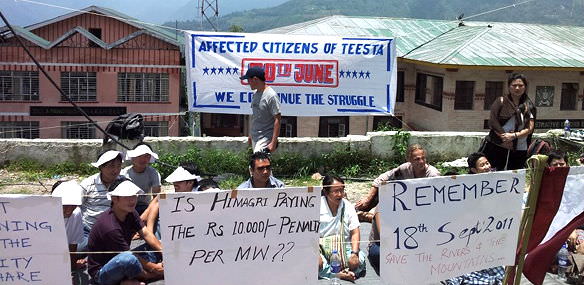
June 20, 2012: The Affected Citizens of Teesta (ACT) commemorated the 5th year anniversary of its hunger strike against hydel projects in Dzongu here with a token dharna in front of the District Administrative Centre, East. The dharna also reminded all of ACT’s continuing stand against hydel projects in Dzongu, two which – Panan and Teesta Stage-IV – still remain.
Today’s dharna was also joined by members and representatives of the All Sikkim Educated, Self Employed and Unemployed Association (ASESE&UA), Sikkim Bhutia Lepcha Apex Committee (SIBLAC), Concerned Lepcha’s of Sikkim (CLOS), Save Sikkim, Sikkim Bikers Groups and other organizations registering their support of the ACT stand.
Speaking to the mediapersons at the dharna, the ACT General Secretary, Dawa Lepcha, informed that after completing the Dharna, ACT members would call on the Chief Secretary, who is also the Chairman of the high powered committee on HEPs, and place a memorandum against mega hydroelectric projects in Dzongu. The memorandum seeks the early scrapping of the two HEPs mentioned earlier, which, ACT highlights “have been a thorn in the hearts of Dzongu ... the last bastion of Lepcha culture and existence”.
The project affected area, apart from being precious for the Lepchas, is also ecologically fragile with the Khangchendzonga National Park and Biosphere Reserve forming a major part of Dzongu, the memorandum adds. Preliminary investigation works of the projects which involved blasting have resulted in “unprecedented landslides” in an already geologically fragile area, the memorandum further contends. Welcoming the scrapping of HEPs in Lachen and Lachung, ACT has reiterated that mega dams should be discontinued in the state as Sikkim falls under seismic zone V.
The ACT General Secretary further explained that the objective of today’s Dharna was to reiterate ACT’s opposition to HEPs in Dzongu. Meanwhile, Save Sikkim member, T R Kharga, said that HEPs must not be encouraged at the cost of the environment, dharma, faith, beliefs and ecology and “most importantly the tug of war with nature should be stopped at once”. He went on to say that Save Sikkim was still opposing the Tashiding HEP in West Sikkim (the only hydel project left on the Rathong Chu, the rest having been scrapped) for which the construction company was continuing with blasting works in an area where tremors are regularly felt.
Sikkim scraps 4 hydel projects after public ire
Report by Vishnu Neopaney at Seven Sisters Post of June 10, 2012
AK Giri, principal chief engineer of the power and energy department, confirmed the development to Seven Sisters Post, saying that the decision was taken by the Sikkim Cabinet recently in view of the people’s apprehension that the projects will cause immense harm to the fragile ecology of the Himalayan state. The four projects are the 99-MW project at Bop, the 99-MW project at Bhimkang, 99-MW project at Lachung and Lachen Teesta Stage-I 280-MW hydro-electric power project. The four projects were planned at Lachen and Lachung in North Sikkim on three tributaries of the Teesta and Lachen rivers.
The second-smallest state after Goa, Sikkim is fed by numerous rivers and streams which originate in the Himalayas. Hydro-electric power contributes a major chunk of energy to the landlocked state, where tourism is the major revenue-earner for the government.
The Lachen Hydro Electric Project had envisaged utilisation of the water of the river Teesta for power generation by constructing a runof-river type dam at the confluence of Zemu Chu and Teesta rivers. However, the public had objected to the project citing the fragile ecology in the young mountain ranges. The government of Sikkim had signed Memorandums of Understanding (MoUs) in 2005 for Teesta Stage-I with Polyplex Corporation India Private Limited of Chandigarh and for the other three projects with Himalayan Green Energy Pvt. Ltd, a codeveloper of Polyplex Corporation India Private Limited of Chandigarh.
Giri said that the despite signing the MoUs, the companies had failed to prepare the detailed project reports (DPR) for the proposed hydro power projects to be built, operate and maintained by the private sector for 35 years. He added that the power developer on whom Sikkim government had entrusted the job of the four power projects, failed to convince the people and the ‘dzumsa’, the region’s highly-powerful traditional ruling body which acts like a self-government. The official added that after the developers failed to convince the people and the dzumsa, the state government had tried to reach out to the people. However, with the opposition mounting, the government decided to respect the people’s wishes and scrapped the projects.
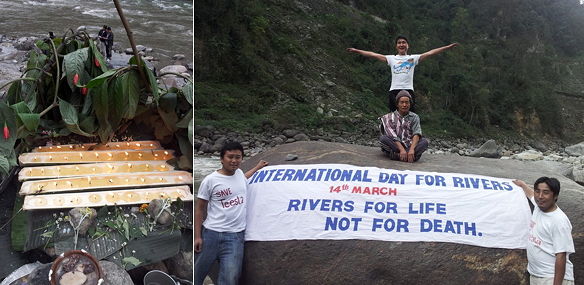
International Day of Action for Rivers 2012: Ritual along Teesta River
A riverside ritual was performed by a Lepcha tribal shaman on the bank of the river Teesta in Sikkim, India to observe the International Day of Action for Rivers on the 14th March. This river is being targeted with series of dams, and this is the last free flowing stretch of the river.
The organization Affected Citizens of Teesta (ACT) organized the program and pledged to fight on for the protection of the river Teesta.
This action is also part of a Panos South Asia's Relay's campaign to increase media coverage of critical national development issues.

| SATYAGRAHA |
Warriors for a Cause
"I will die but won't allow the mega power projects in Dzongu" - Dawa Lepcha.
Two Lepcha youths from Dzongu rocked the state of Sikkim and the world with their selfless stand against the hydro projects. Dawa T. Lepcha and Tenzing Lepcha went on hunger strike in the spirit of Gandhian Satyagraha from June 22, 2007 to September 27, 2009.
Chronicles of the campaign - and more - at
| TEESTA |
Will the Teesta river survive? In order to construct one kilometer of tunnel, approximately 150 tons of dynamite are required. Imagine how much blasting will be done for 30 power projects! Seventy percent of the river to flow underground!
| DZONGU |
Dzongu in North Sikkim is the holy place for Lepchas spread all over the world. Process has begun for seven mega power projects spanning the length and breadth of this protected area.
| ENVIRONMENT |
Environment Impact Assessment (EIA)
Blatant violations of procedural and environmental norms. Get the distressing facts at our EIA-page.
| TEESTA STAGE V |
Much went wrong during design, assessment and construction of Teesta Stage V HEP. For a truly sustainable and adapted development, a different approach is required.
| VIOLATIONS |
Environment Protection Act (EPA) as well as Forest Conservation Act (FCA) were repeatedly violated by the companies involved. A non-exhaustive listing for Teesta Stage V only (NHPC).
| DOCUMENTS |
• Statements, appeals and proceedings by ACT
• Scientific papers substantiating ACT's concerns
• Press reports covering disproportionate projects in Sikkim and ACT's struggle for protection
| MEDIA |
• Photo-Galleries
• Collection of Documentaries

Lepchas - A vanishing Tribe
© Affected Citizens of Teesta 2007 - 2023
NGOs supporting ACT: Concerned Lepchas of Sikkim (CLOS) - Sangha of Dzongu (SOD) - Citizens Forum of Sikkim (CFS) - Sikkimese Association for Environment
While all the organizations supporting ACT share the common goal of protecting the environment, individual groups can, and sometimes do, differ in their approaches to specific issues highlighted above. The stand taken by ACT does not necessarily includes of everybody in Sikkim and other parts. If anyone wishes to differ, they are welcomed to put forward their views, comments and disagreements to info@actsikkim.com. Everybody is welcome!